
Acoustic test booth
Acoustic test booth
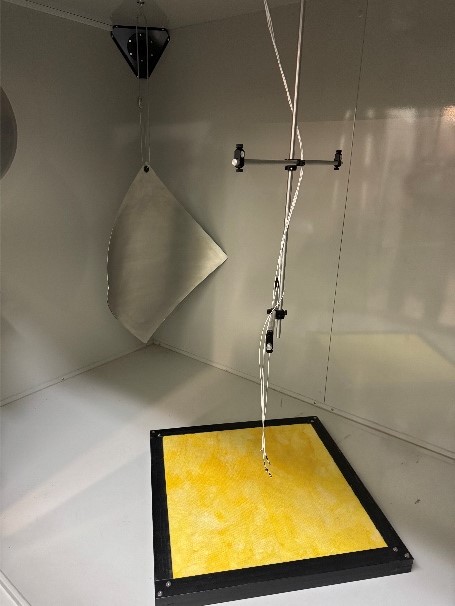
| MANUFACTURER | Mecanum inc. |
|---|---|
| MODEL | Mecanum’s Acoustic Test Cabin (logiciels Alpha-X et TL-X) |
General description:
Compact reverberant chamber allowing measurement, in a quasi‑diffuse field, of the acoustic absorption and transmission loss of materials and assemblies. Absorption is determined from the sound decay rates measured by four microphones distributed throughout the chamber, in accordance with ASTM C423 (equivalent to ISO 354), while transmission loss is obtained by surface intensity measurements on the specimen, in accordance with ISO 15186. The system is operated using the Alpha‑X (absorption) and TL‑X (transmission) software, which manage sensor calibration, data acquisition, calculation, and test archiving.
Applications:
Characterization of absorbing materials and panels; evaluation of the acoustic insulation of building systems; development of acoustic products made of wood and bio‑based materials; comparative testing and quality control.
Characteristics:
- Measured properties: acoustic absorption coefficient (α), reverberation time (RT60), and transmission loss (TL), among others
- Results calculated in octave and one‑third‑octave bands using the Alpha‑X and TL‑X software
- Four loudspeakers, four pre‑calibrated microphones, four diffusers, audio amplifier, and data acquisition system (DAQ)
- Intensity probe enabling transmission‑loss measurements on one face or five faces
- Samples: recommended minimum surface area of 1 m² for absorption; square panels 66 to 70 cm per side for transmission‑loss testing
- Recommended overall sound pressure level of 110 dB inside the chamber; optional weather stations for monitoring ambient conditions
- Estimated indices E_NRC, E_SAA, E_STC, and E_Rw calculated over the chamber’s valid frequency range
- Absorption: preliminary measurement of the empty chamber, followed by measurement with the specimen; 13 tests of 5 seconds recommended, with Schroeder reverse integration to improve decay quality
- Transmission loss: intensity probe assembled with a 12‑mm spacer; measurement on one face or five faces (30‑second acquisition after a 2‑second delay) and supplied mounting‑frame set
- Labeled and pre‑calibrated IEPE microphones: individual calibration or automatic calibration of all channels using the calibrator
- Operating conditions: ambient temperature from −10 to 40 °C and relative humidity from 40 to 80% (decreasing linearly above 31 °C), in a room with low background noise and low vibration
- Automatic logging of atmospheric conditions via Mecanum weather stations (or manual entry); test management, global average calculations, and results export




To use this equipment
The equipment available is accessible to the academic and industrial research community.
To learn about usage conditions and availability, please fill out the form below. After reviewing your request, we will contact you shortly to offer you the best available solution.